|
|
Carrie Wilson, Office of Communications, CalOutdoors@dfg.ca.gov
California Outdoors Q&As:
Question:
I was wondering how Fish and Game plants fish in high elevation lakes and ponds in the Tahoe National Forest, where you can only reach them by hiking? (Bradley G.)
Answer:

The Department of Fish and Game (DFG) uses a variety of methods to release fish into waters designated for receiving fish. In high-mountain waters that our planting trucks cannot reach, approximately 95 percent of the fish are planted by air. We also transport fish for planting by horse, mule and backpack.
DFG is very selective in planting high mountain lakes. Lakes that are planted do not receive plants every year. According to Dr. William Cox, DFG Program Manager for Fish Production and Distribution, that is not necessary because the fish grow very slowly and the successive year plants would not produce fish with notable size differences. Usually they are planted every second or third year.
At lower elevations most planting is done by trucking fish to designated sites.
Bears and Kids
www.dfg.ca.gov/QandA
Question: I have a question about bears and kids. We live on 10 acres where we have a large garden, fruit trees, berry bushes and two horses. We definitely have bears that come around as our fruit trees (and those of our surrounding neighbors) have claw marks on them as evidence. My concern is for my six-year-old-son who enjoys playing outside. Although I keep an eye on him, there are times when he plays unsupervised.

My question is: If children encounter bears should they follow the same advice as adults – stand still, face the animal but don’t stare, make noise and try to appear as large as possible? I understand to teach him not to run, but if a bear comes up close he would be so much smaller than the bear and so vulnerable. There is no way he could make himself bigger than the bear or have a loud and deep enough voice to scare it off. Shouldn’t I also teach him to back away slowly and get inside? Is standing there looking at the bear and calling for me the best thing to teach him? I need some advice on how to teach my child exactly what he should do. Thank you. (Kelly, Crescent City)
Answer: I certainly understand your concern. According to Department of Fish and Game (DFG) Senior Wildlife Biologist and bear expert Doug Updike, children should follow the same procedures as those given for adults, which you mentioned. Bears are more attracted to fruit, food and garbage, however, than to people, but the very best situation is that your children not find themselves in a vulnerable or unsupervised position in the event of a surprise visit.
If you have wild animals in your area, you need to closely supervise your children. Mountain lions and coyotes pose a much greater threat than a bear. Still, the likelihood of having your child attacked by a bear, mountain lion or coyote is extremely low as wild animal attacks, while tragic, are not common.
For more on living safely with bears, lions and coyotes, please visit DFGs Keep Me Wild Web site at www.dfg.ca.gov/education/living.html.
Carrie Wilson is a marine biologist with the California Department of Fish and Game. Her DFG-related question and answer column appears weekly at www.dfg.ca.gov/QandA. While she cannot personally answer everyones questions, she will select a few to answer each week. Please contact her at CalOutdoors@dfg.ca.gov.
Share Mountain Valley Living with your friends:
Watch Out For Ice Out!
Capt. Bryan Roccucci / Big Daddy’s Guide Service
 Brian Shontz of Davis CA with a 20 pound Mackinaw caught at Bucks Lake on the first day a boat could be launched.
Many anglers eagerly await several events each year in hopes of hitting the water for some premier fishing. For some, who enjoy fishing moving water, opening day of stream season gets marked on the new calendars only seconds after the cellophane wrapping is removed. Others will block out time centered around a lake’s opening day or a particular species season on the ocean. These are usually dates set by the state and can be found in the current regulations, but there are other times that lake anglers look forward to each year that are much more illusive. The dates are not found in any regulation or set by state departments, these dates are determined by Mother Nature. What avid angler can forget about the fall trip when they timed it right and were on the water when all the conditions came together for a lake to “turn over” and the fish feeding frenzy that ensued. This time of year many of us are impatiently waiting for a favorite lake’s ice cap to recede, and access to be granted, to what can be the ultimate fishing experience. This is known as “ice out”.
Ice out is an important time of year for the fish, signaling a time of new food sources. During the winter months while the lake is capped with ice, fish are left to forage food found only in the lake and as winter wears on many of these sources can dwindle. With the melting ice comes melting shore line snow creating run-off that brings all sorts or new food as well as nutrients that replenish the lakes food chain. The sun warmed surface waters further promote the food chain’s life cycle. The warmer surface waters also attract the fish and begin to spur their metabolism and their feeding drive.
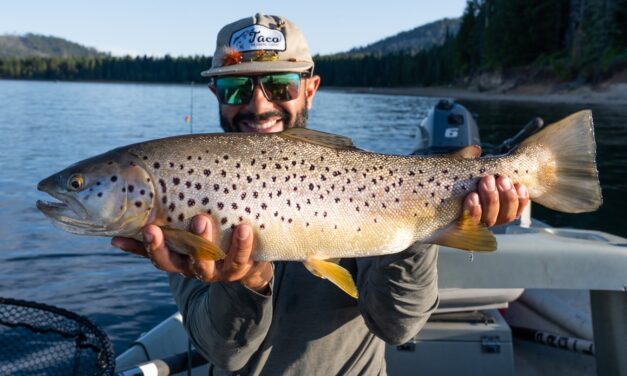
 Rick Kennedy of Davis CA with an early season Brown caught at Bucks Lake right after ice out.
Ice out can also be a great time for the fisherman. It should be readily apparent that we have almost a “perfect storm” of conditions. 1) Fish have had several months of limited to non existent fishing pressure. 2) The fish are hungry and they are actively searching for food. And 3) They spend a lot of time at or near the surface making them easier for fishermen to target. With all of these conditions present, its no wonder the fishing can be so incredible.
If there is a negative or a down side it would have to be comfort for us the anglers. Many times access to these waters is far from easy. Shore anglers may have to trudge through deep rotting snow to get to the water’s edge. Boat anglers may have it even worse, with winter like road conditions not to mention snow covered boat ramps. Many boaters choose to use smaller more portable boats and slide them across the snow to gain access. All of this to experience a magical time called “ice out”
A word of caution; dealing with some of these conditions can be very hazardous. You should be prepared to deal with any and all situations and even though the calendar says spring, in most of these remote locations it is still very much like winter. You should dress properly and bring plenty of supplies and it is always a good idea to let someone know where you are going and when you plan to return.
 The author Capt. Bryan Roccucci displays a large Bucks Lake Mackinaw before it is released.
About the author:
Capt. Bryan Roccucci is a full time professional fishing guide and operator of Big Daddy’s Guide Service. Bryan specializes in year round trophy trout fishing while emphasizing light tackle fishing techniques on Lake Almanor (Jan.-May), Lake Davis (May – June), Bucks Lake (June – Sept.), Eagle Lake (Sept. – Dec.) To book an “ice out” trip at Bucks Lake or any of the other waters fished by Bryan or for more information please visit www.bigdaddyfishing.com or call (530) 283-4103.
Copyright © 2009 Bryan Roccucci All Rights Reserved
Share Mountain Valley Living with your friends:
Question:
I live in a residential area and raccoons have begun visiting my backyard at night. They are using my yard as a rest stop in their nightly urban foraging. Our backyard is landscaped including a grass lawn. I am looking for anything short of cages to discourage them. Is there any non-toxic substance I can spread near their entrance/exit point to discourage their visits? They do not appear to be eating or digging up anywhere in the yard, but they’ve adopted my yard as their restroom. Thank you in advance for any insight or suggestions you may have. (John W.)
Answer:
We see an upsurge in raccoon sightings and reports this time of year because youngsters born in the spring are now independent of their moms and the adults are building up their fat reserves for the winter.
According to Department of Fish and Game (DFG) Associate Wildlife Biologist Jeff Cann, you should first remove all attractants from your yard such as pet food, dropped fruit, old garden vegetables, and securely close all garbage cans and compost heap containers. Even water can be an attractant this time of year, so if you have a fountain or fish pond, try to make it off limits (e.g. electric fence or dry it out). If the raccoons are coming in through holes in the fence, block those entry points with wire, wood or some other barrier.
Keep in mind that raccoons are excellent climbers and are capable of gaining access to yards by climbing fences or using overhanging limbs to bypass fences altogether. Cutting overhanging limbs may help to keep them from dropping in. If the raccoons are climbing over your fence, one deterrent could be to line the top with spikes or sharp tack strips. An easy way to do this is via carpet tack strips which are essentially a lot of little nails anchored in wood that carpet installers use to stretch carpet over. If you completely line the top of the fence with these then the raccoons will not use the top board as a transit way either. A “hot wire” from an electric fence charger at the top of the fence will greatly increase the effectiveness of a fence for excluding raccoons but you’ll need to find a way to properly ground it.
While these may all seem like extreme measures, the point here is to make your yard less hospitable than your neighbors so the pesky critters will move on.
DFG Senior Wildlife Biologist Terry Palmisano also offers that if you’re thinking about chemical detractors, there are no registered toxicants or fumigants that we are aware of available for control of raccoons, but Capsaicin (a chile pepper extract) is registered as a repellent for raccoons. It may be useful in deterring trash-raiding raccoons.
A great place for more information is the University of California Integrated Pest Management Program page on raccoons: www.ipm.ucdavis.edu/PMG/PESTNOTES/pn74116.htm. Good luck!
raccoon (Procyon lotor) Raccoon (Procyon lotor)
US Fish and Wildlife photo by Dave Menke
Question:
My brother and I have two burning questions we have been wondering about. Is it legal to use licorice to fish with as bait? Also, we observed a man with a syringe injecting air into his bait worms so they would float off the bottom. Is this legal? (Marcus O.)
Answer:
Processed food, such as licorice, are legal under bait regulations for inland waters found beginning in section 4.00 CCR, Title 14. It is also legal to inject air into a fishing worm and many such kits are found at sporting goods outlets. This method can be a very effective way to keep a worm off the bottom of lakes with heavy bottom vegetation.

Share Mountain Valley Living with your friends:
California Hunter Education Program
In a continued effort to reduce firearm accidents, the State of California requires all first time resident hunters, regardless of age, to complete hunter education training or pass a comprehensive equivalency test before purchasing a hunting license.
The California Department of Fish and Game conducts training throughout the state. Each year approximately 30,000 students complete the state’s ten-hour minimum hunter education course. Statistics show hunter education training is a success.
Hunting accidents of all types have declined substantially since the start of the program. The California Hunter Safety Program began on January 1, 1954 with the passage of the Davis-Abshire Hunter Safety Training Law. The initial law required all junior hunters to take a Hunter Safety Class prior to obtaining their first hunting license.
For information on classes and on-line classes, contact:
Hunter Education Program
1416 Ninth Street, Room 1326
Sacramento CA 95814
(916) 653-1235
Share Mountain Valley Living with your friends:
This time of year, deer hunters are on the move in Northeastern California, each in search of the big buck. It turns out they spend a lot of bucks doing so too. With deer being the most popular and accessible big game animal in the state, hunters stimulate the economy. According to California’s Department of Fish and Game (DFG), 150,000-plus deer hunters spend millions of dollars in licenses and deer tags, which is important for wildlife management programs. In addition to funding general wildlife management activities, 54% of all deer tag fees are funneled specifically into deer projects via the Deer Herd Management Program which was created by law and enacted in 1984.
According to DFG statistics, hunters also spend millions of additional dollars on equipment, travel, provisions and lodging. One study by CA DFG estimates that deer hunters help support nearly 8,000 jobs in the private sector.
Local businesses in the northeastern region are eager to welcome hunters. Deer hunting season comes just after the summer tourist season has wound down.
Share Mountain Valley Living with your friends:
There is nothing like a visit to the great outdoors. Fresh air, water and sunshine and kickin’ it in the woods are my favorite part of the mountain summer. However, there are a few things we all need to remember to keep camping safe and the wildlife wild. Always keep food items locked up and/or out of reach. Bear, mountain lion, bobcat, raccoon, chipmunk, squirrel and many other animals are opportunistic feeders and will try to get anything they can smell and reach. Continue reading Keeping Camping Safe and Wildlife Wild
Share Mountain Valley Living with your friends:
May 2008
Share Mountain Valley Living with your friends:
|
|